

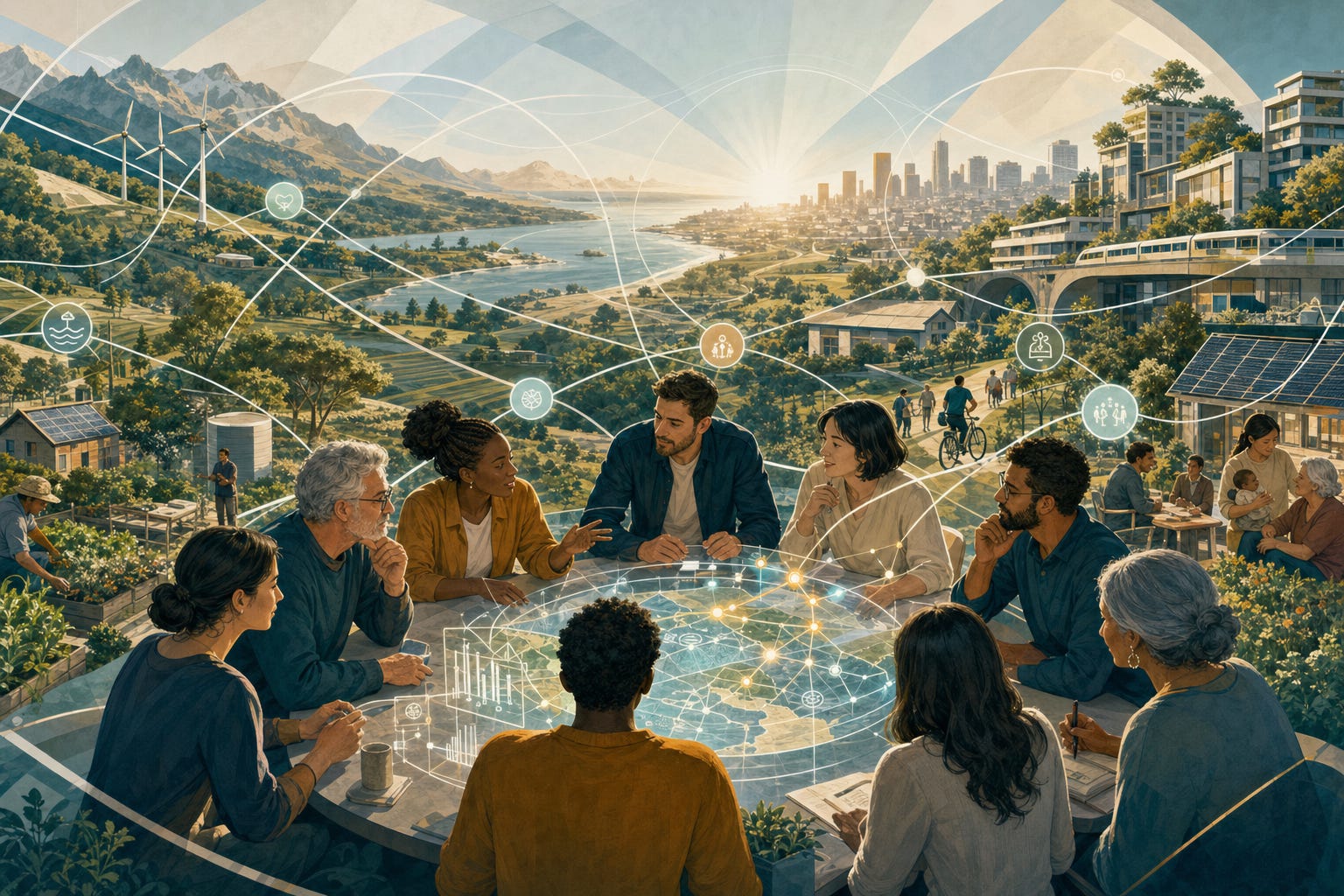
AI can help people see connected systems and cooperate, while people remain responsible for values, goals and decisions.
Back in 2022 I wrote 2030 One World, a cookbook of ideas for how people could work together to change the world. The central idea was that a significant number of people had stopped waiting for governments, political parties and powerful organisations to decide the future for them, and had begun taking greater responsibility for shaping it themselves.
Not as isolated individuals, and not by trying to force everyone else to agree with them. They did it by choosing to cooperate. The approach was voluntary: people and communities opted in because they accepted some shared principles and believed they could achieve more together than they could separately.
AI had a role in that vision, although the technology available at the time was nowhere near what we have now. Its role was not to govern people or decide what was right. It was to help people clarify their ideas, examine evidence, compare different futures and work backwards from the future they wanted to build.
At the time I could imagine the destination more easily than I could explain how we might get there. That is beginning to change.
What has changed
The public debate about artificial intelligence is dominated by one question, and it is the wrong one to build on:
What will AI do to us?
Will it take our jobs? Will it overwhelm us with false information? Will a small number of companies become even more powerful? Will AI systems become too difficult to control? These are real questions that need serious answers.
But there is another question I want to explore:
What can we do together because AI now exists?
What can ordinary people now understand, model, compare and coordinate that was previously beyond their reach? That is an opportunity receiving far less attention.
Over the past few years I have used AI to do work that would previously have required teams of researchers, analysts, designers and programmers – or would simply have remained beyond my reach.
The tools are far from perfect. They make mistakes, they can sound confident when they are wrong, and they reflect the limitations of their data and design. But in my experience their usefulness has grown at a remarkable rate. They can already help an ordinary person examine a complex subject, organise large amounts of information, compare competing arguments, identify assumptions, draft models, explain difficult ideas and turn a vague intention into a practical plan.
Each of those capabilities matters on its own. Together, they change what ordinary people are able to do.
The problem is that everything is connected
Most of the serious problems facing us do not sit neatly inside one government department, one community or one country. Housing connects to migration, planning, finance and employment. An ageing population connects to health, care, workforce participation and productivity. Climate disruption connects to infrastructure, insurance, migration and social cohesion. Artificial intelligence connects to employment, productivity, energy use and the distribution of power.
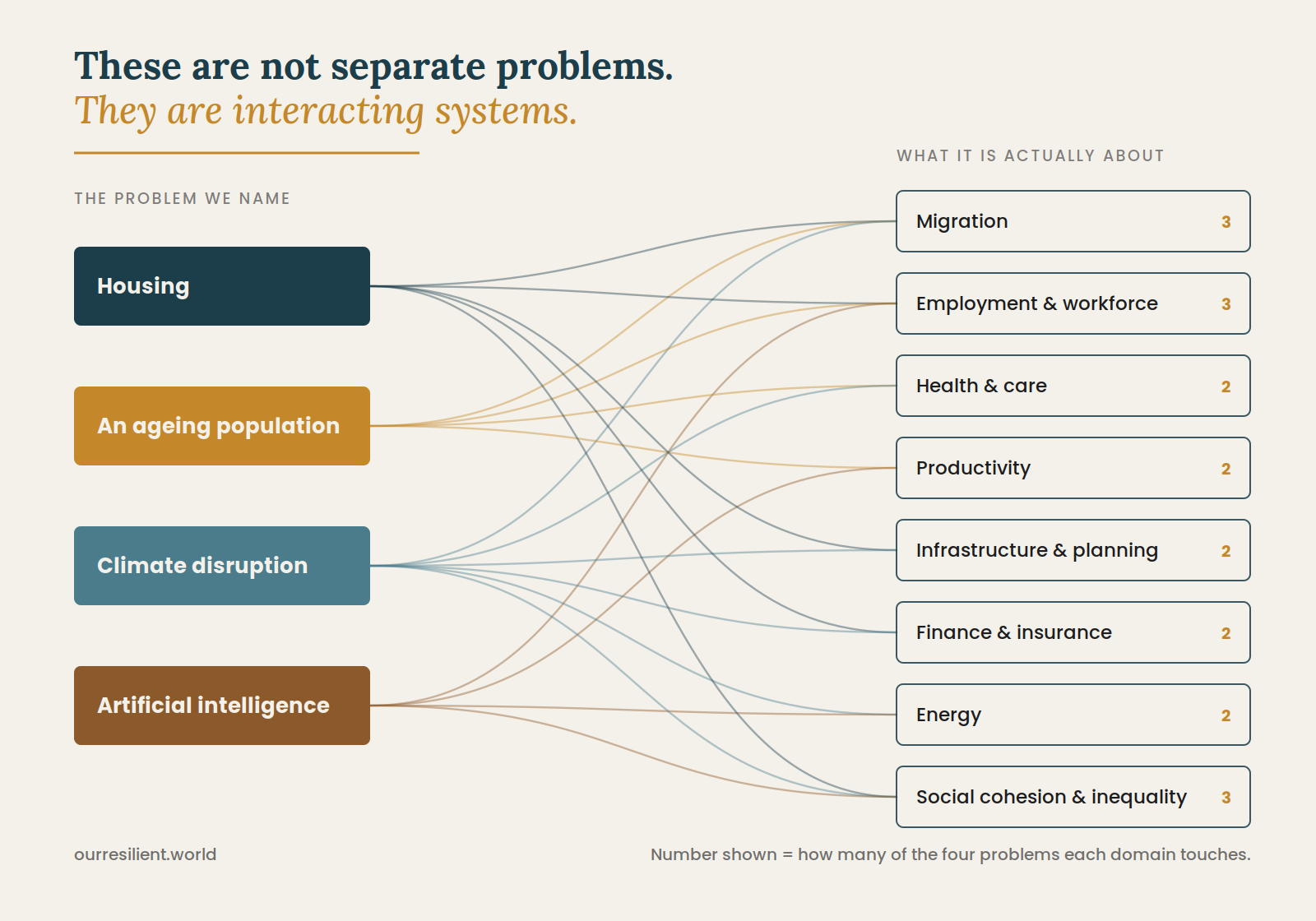
The numbers show how many of the four named problems touch each shared domain.
These are not separate problems. They are interacting systems. Yet our institutions still divide them into separate portfolios, reports, budgets and political arguments.
That is understandable — human beings have limited time and attention, so we simplify complicated issues in order to deal with them. The problem is that the world does not stay simplified just because our institutions are organised that way. A decision that improves one part of the system can create new problems elsewhere. A policy that looks effective over three years can make the country less resilient over ten. A national solution can fail when the most important drivers operate across borders.
We need help seeing more of the system. AI may provide some of that help.
What AI does, and what stays with us
I do not think AI should decide the future for us. Only people can decide what kind of society they want to live in, what trade-offs they are prepared to accept and what they owe to one another.
People decide:
• Values and priorities
• What trade-offs are acceptable
• What we owe one another
• The final call
• Who is accountable
AI can help by:
• Making assumptions visible
• Bringing together evidence from different fields
• Showing where experts agree and disagree
• Exploring the consequences of different choices
• Explaining complex models in language more people can understand
• Recording decisions and unresolved questions so groups can learn from earlier attempts
Most importantly, it makes these capabilities available beyond governments, universities and large corporations. That is the shift. We now have tools that could help us cooperate at the same scale as the problems we need to solve.
The word could is doing real work in that sentence. AI will not create cooperation by itself, and it can just as easily be used to manipulate, divide and concentrate power. The opportunity exists only if people choose to use these tools differently.
Why resilience, and why 2035
Every serious policy discussion should begin with a goal: what are we trying to achieve, what does success look like, and how will we know whether we are moving towards it? Too often the debate starts with a policy answer before there is any agreement about the outcome. One side proposes more government spending, another proposes lower taxes; one argues for regulation, another for competition. It becomes a contest between positions, with the goal assumed rather than stated.
I want to start with a simpler goal: a more resilient world by 2035. Not a perfect world, and not a world without conflict, inequality or risk — a world better able to anticipate shocks, preserve what matters, recover when systems fail and adapt when circumstances change.
Resilience gives us a direction without pretending everyone will agree on every detail, and it forces us to consider the whole system:
• A country is not resilient if its prosperity depends on fragile supply chains it cannot influence.
• A community is not resilient if the people who keep it functioning cannot afford to live there.
• An economy is not resilient if productivity gains flow mainly to those who already hold wealth and power.
• A democracy is not resilient if citizens cannot distinguish evidence from manipulation, or see how major decisions were reached.
• A world is not resilient if every country protects itself while the global systems they all depend on keep weakening.
2035 is close enough to matter and far enough away to make structural change possible, without becoming an excuse for postponement. Most of us struggle to imagine 2050 in practical terms, and it is easy for governments to announce distant targets that someone else will have to deliver. The decisions made in the next few years will shape what is possible by 2035 — and AI's capabilities will change dramatically over that period even if the current rate of improvement slows. We do not need to predict exactly what the technology will become. We need to decide how we want to use the capabilities already in front of us.
Personal responsibility does not mean acting alone
"Personal responsibility" is usually code for the idea that individuals should simply look after themselves. That is not what I mean. No individual can solve climate disruption, redesign democracy, rebalance the economy or manage technological change.
Personal responsibility begins with deciding not to remain only a spectator. It means accepting some responsibility for the systems we participate in and the future those systems are creating. But responsibility only becomes useful when people can cooperate.
The scale of the problems means cooperation must eventually work across borders. I do not have a settled institutional design for that cooperation, and I do not want to assume an answer at the beginning of the series. The destination is a more resilient world built through voluntary cooperation. How that cooperation should be governed is one of the questions the series must examine openly.
That does not begin with a new institution being declared into existence. It begins with the people already trying to help and most importantly it begins with the people who care but can’t see anyway they can make a difference. Like me they have held of on getting involved because they see that the problems we have to solve effect the world, not their nation or community. These problems can’t be solved by focusing on climate change, inequality, etc etc. These problems can only be solved by voluntary collaboration to define a future state and then working backwards to decide how to move towards it.
Many of us understand the problems facing the world need to be thought about as ‘world’ problems. The opportunity AI gives us is the ability for individuals who have felt powerless to start to find ways to cooperate with others to see if they can define what a 2035 resilient world could look like and then start to work to create it. My task and my commitment is to stop thinking about how we might do this and to start to build examples of how we can use AI to do things that just have not been possible before.
Voluntary, or it is not worth building
This is why voluntary participation matters. Any system built around these ideas has to be voluntary. It cannot be another attempt to impose a single answer on everyone. People, organisations and countries will disagree about values, priorities and acceptable trade-offs, and some will not want to participate at all. That is their choice. The aim is not universal agreement — it is to create better ways for those who do want to cooperate to do so openly, fairly and effectively, at the scale the problems actually operate on.
That means the assumptions must be visible, the evidence open to challenge, alternative pathways genuinely considered, models improved when reality shows they are wrong, and decisions accountable to the people affected by them.
AI could make this kind of participation far more practical, but it cannot guarantee it. The design of the institutions still matters, and those questions are human ones:
• Who owns the systems?
• Who can inspect them?
• Who can contribute?
• Who benefits?
• Who can challenge a decision?
An exploration, not a finished answer
Our Resilient World will work through these ideas over time. I do not have a finished blueprint, and I do not believe any individual, government, company or AI model could produce one — the challenge is too complex and the future will keep changing.
What we can do is set a direction, explore different pathways, test small parts of the approach and learn openly from the results. Over the coming months I want to ask what a more resilient Australia might look like by 2035, why that resilience depends on cooperation beyond our borders, and what an opportunity-first AI policy would actually look like. I want to explore how open models, simulations and backcasting can help people move from a preferred future to practical action — and build small prototypes, not because they are the answer, but because working examples let ideas be tested.
That is where I want to begin. Not with another argument about whether AI is good or bad, and not with a promise that technology will save us. With a more practical question:
Can we use these new tools to help ordinary people understand complex systems, cooperate more effectively and take a greater role in building the future?
I think the opportunity is real. Whether we use it is up to us.