

In the first story in this series, I argued that for the first time in history, humanity has tools that can help us cooperate at the same scale as the problems we need to solve.
If that is true, Australia needs to ask a much bigger question about artificial intelligence.
Most AI policy starts here:
How do we regulate it?
How do we manage the risks?
How do we protect jobs?
How do we control the building of data centres?
How do we stop harmful uses?
All of those questions are important, but they are not enough. They start from the assumption that AI is mainly something being done to us, and that government's job is to control the consequences.
I want to start somewhere else.
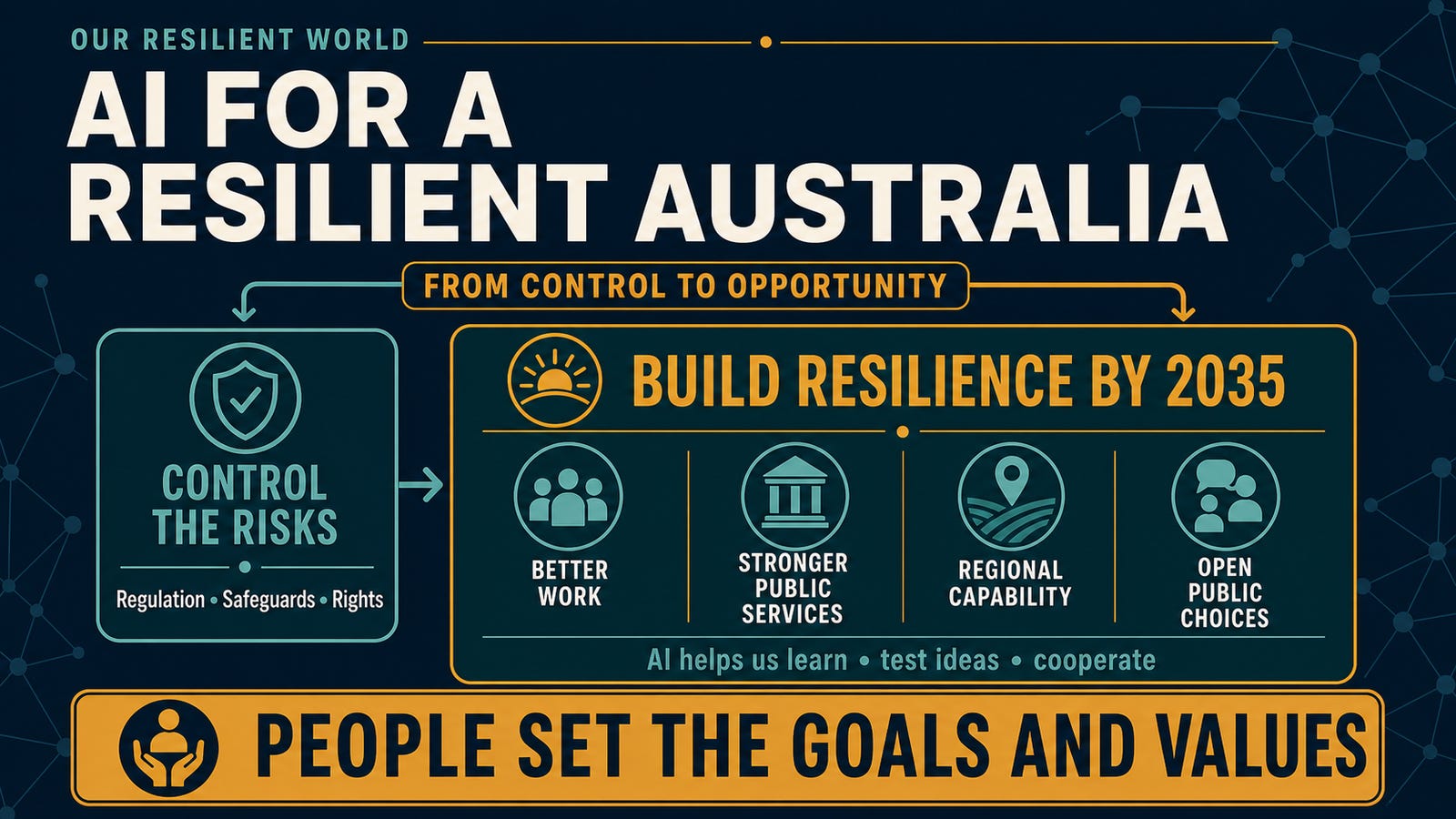
How can Australia use AI to become more resilient by 2035?
My working definition of resilience is:
A resilient world is one in which people, communities and institutions have the capacity and ability to live well through disruption while continuing to shape a better future. It can meet essential needs, maintain social cohesion, sustain functioning economies and critical systems, protect the natural systems on which life depends, and adapt to technological, demographic, environmental and geopolitical change.— About Our Resilient World
A prediction I am prepared to be wrong about
Proposals for new AI policy have many starting points, and three are running in Australia right now. South Australia has announced a Royal Commission into Artificial Intelligence. Kate Chaney, the independent member for Curtin, has released an AI Discussion Paper asking for feedback on 18 policy proposals. The Australian Greens have started an inquiry into data centres.
These reports and policy proposals will contain many recommendations on how to control AI, and some will look at the opportunities AI creates. I predict (a testable hypothesis) that not one of them will make its central recommendation about how AI can be used to improve our democracy by empowering people to have more say in how decisions are made, or about how we can use AI to make Australia more resilient.
Looking at the current state of world and Australian politics, AI poses a very significant risk, because it can so easily be used to distort facts and promote division. That is exactly why the focus of AI policy should be on doing the opposite — using AI to empower people to take more control of their own lives, and to help them find common ground using the same approach that has been used to understand climate change, with one difference. This time, everyone can become a citizen scientist with the help of AI, provided they are given sufficient access to AI compute.
The South Australian Royal Commission will consist of a panel of experts who will hold hearings, take a great many submissions and put together a series of recommendations. That is the process we have always used, and we now have the option to do so much more than this.
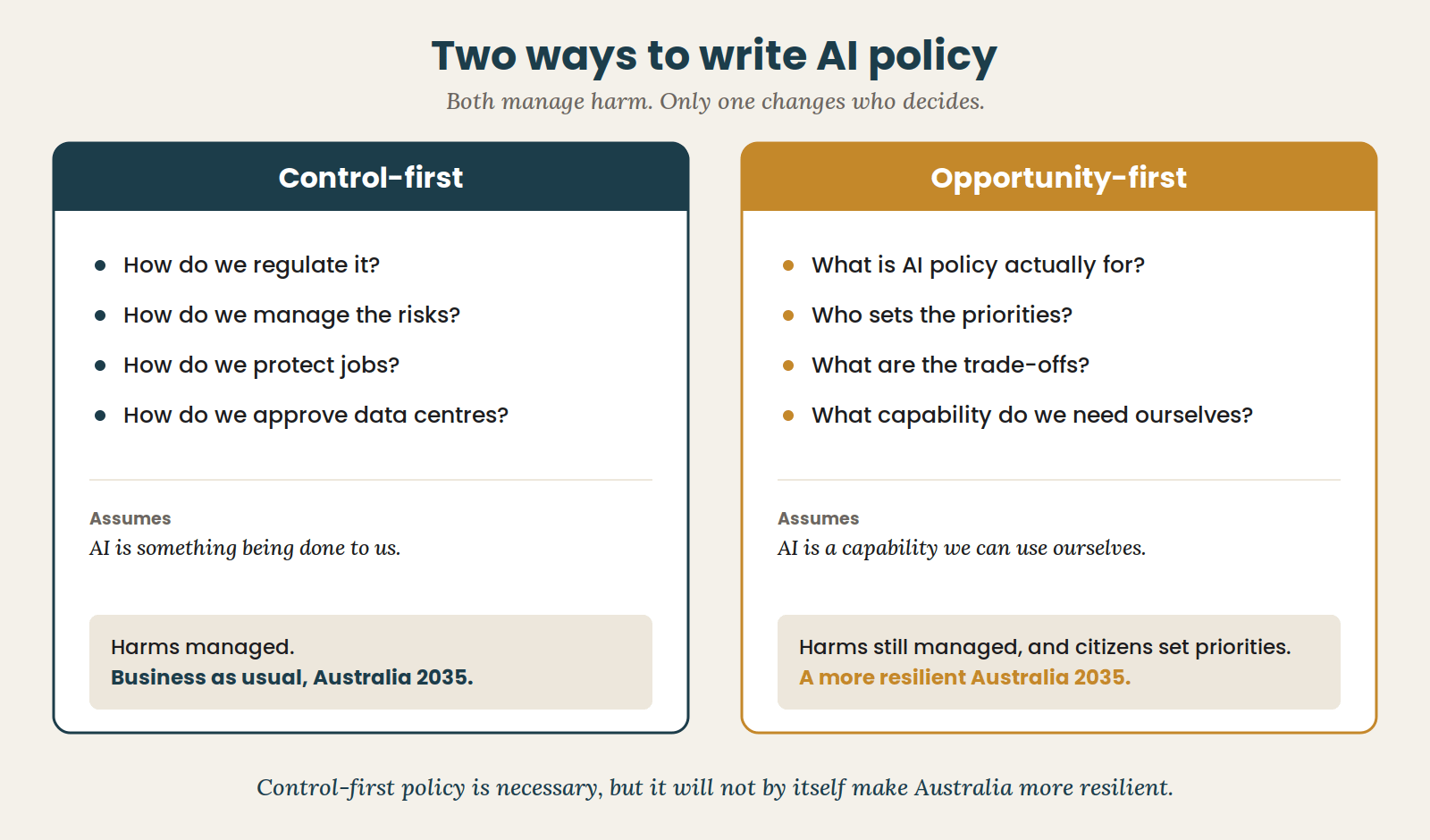
Two ways to write AI policy. Both manage harm; only one changes who decides.
Start with the outcome
Before deciding what AI policy should contain, we need to decide what it is for.
Australia already has plenty of familiar policy goals: economic growth, higher productivity, greater competitiveness, more jobs, stronger national security. All of them are important, and none of them is sufficient, because a country can meet every one of those goals and still be more fragile at the end of it.
A country can become more productive while becoming less cohesive.
It can become wealthier while housing becomes less affordable.
It can create new industries while the benefits flow mainly to a small number of people.
It can build powerful digital infrastructure while the communities providing the land, energy, water and workers receive little long-term value.
That is why I prefer resilience as the goal. A more resilient Australia would be better able to anticipate change, protect what matters, recover from shocks and adapt as circumstances change. More capable, not just richer. More cohesive, not just more efficient. More able to make difficult choices openly, rather than waiting until each problem becomes a crisis.
If resilience is the goal, AI policy is no longer only about controlling a technology. It becomes a policy for expanding Australia's ability to learn, decide and act.
We should stop waiting to be asked
AI will not make Australia resilient by itself, and people remain responsible for the goals, the values and the final decisions. The opportunity is to give people far greater power to be involved and to shape their own future.
A resilient country is not one where the decisions are made by governments who have demonstrably failed the test of building the capacity for a resilient Australia. Business as Usual (BAU) government produces a BAU pathway to the future, in which nothing significant changes and each problem is dealt with only once it has become expensive enough to be unavoidable. All the really important problems we face are not separate problems but interacting systems — housing, energy, care, defence, climate and public revenue are one system, and no minister and no department owns it.
We must move to a world where ‘we the people’ have the ability to set the priorities for government. In Australia we need an AI policy whose most important question is how we use AI to give people the ability to tell governments what their priorities are, while understanding the trade-offs — that spending more on defence or health must mean spending less somewhere else.
Climate showed how far this can go, and where it stops
Climate science built two things that are worth copying.
The Intergovernmental Panel on Climate Change (IPCC) demonstrated that a distributed body of researchers can assemble evidence credible enough to move a global argument and to set out alternative pathways. The EN-ROADS climate simulator demonstrated something I think is more important still, which is that anyone — not only a modeller — can sit down and start to understand the trade-offs involved in reducing global heating.
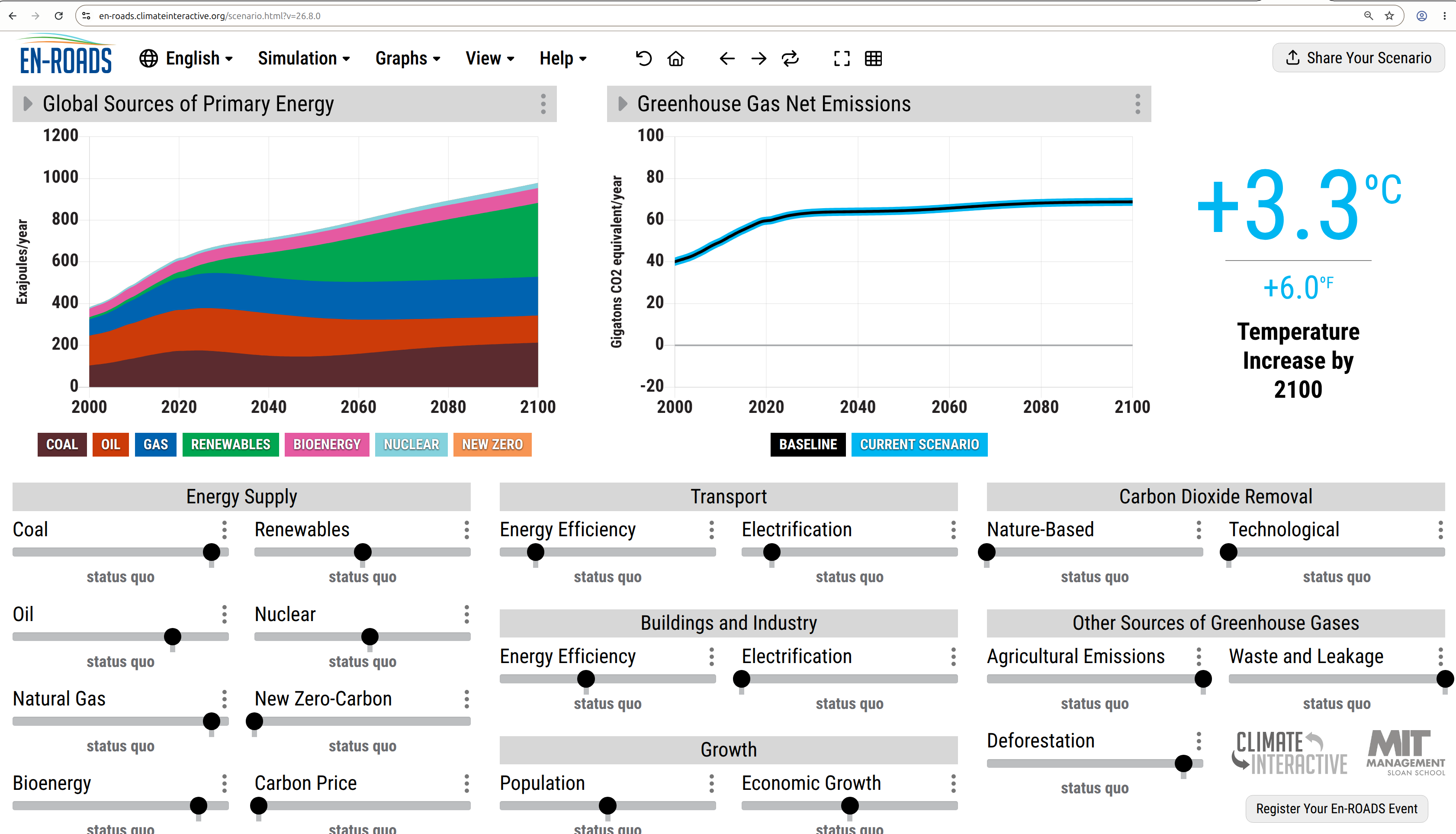
EN-ROADS Climate Simulator— visualise the impact of policy choices and technology improvements.
Then comes the third step, and this is where it fails. The UN Conference of the Parties (COP) hands the decision back to government representatives, and the record shows we cannot rely on them to take effective action. Canadian Prime Minister Mark Carney spoke at Davos in January 2026 of a rupture in the world order, and said that we had always partly known the story of the international rules-based order to be false, because the strongest exempted themselves whenever it was convenient and trade rules were enforced asymmetrically.
The annual COPs just made this process unavoidably visible to all who cared to look. The evidence was never the bottleneck, and neither were the models. The decision step is the bottleneck, and thirty years of COP meetings have not moved it.
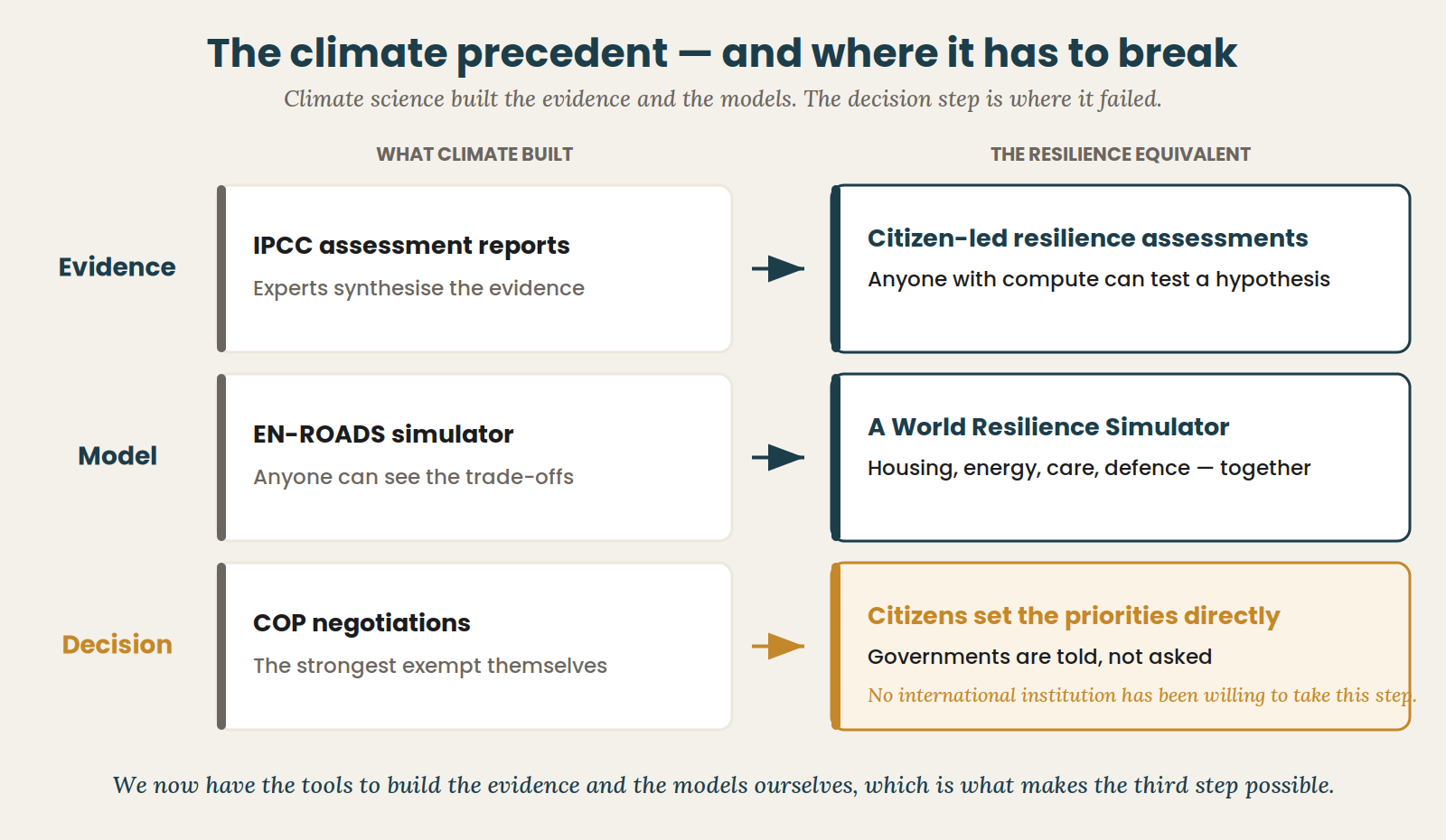
What climate science built, what the resilience equivalent would look like, and the step no international institution has been willing to take.
The first piece of this already works
We must develop the equivalent of the IPCC reports, driven by citizen scientists. We must develop a World Resilience Simulator that can drill down to democratic countries who are willing to act together on priorities that their citizens have discussed and then decided.
That is a very large ambition, so I built the smallest working piece of it to find out whether any of it is real. I took one question about AI and work out to 2035 — whether AI and robotics will mainly displace or reshape entry and re-entry work, or whether they can open viable business-creation pathways across age groups — and tested it across three reports and five separate hypotheses, using one AI agent to do the research and a second AI agent to check the first.
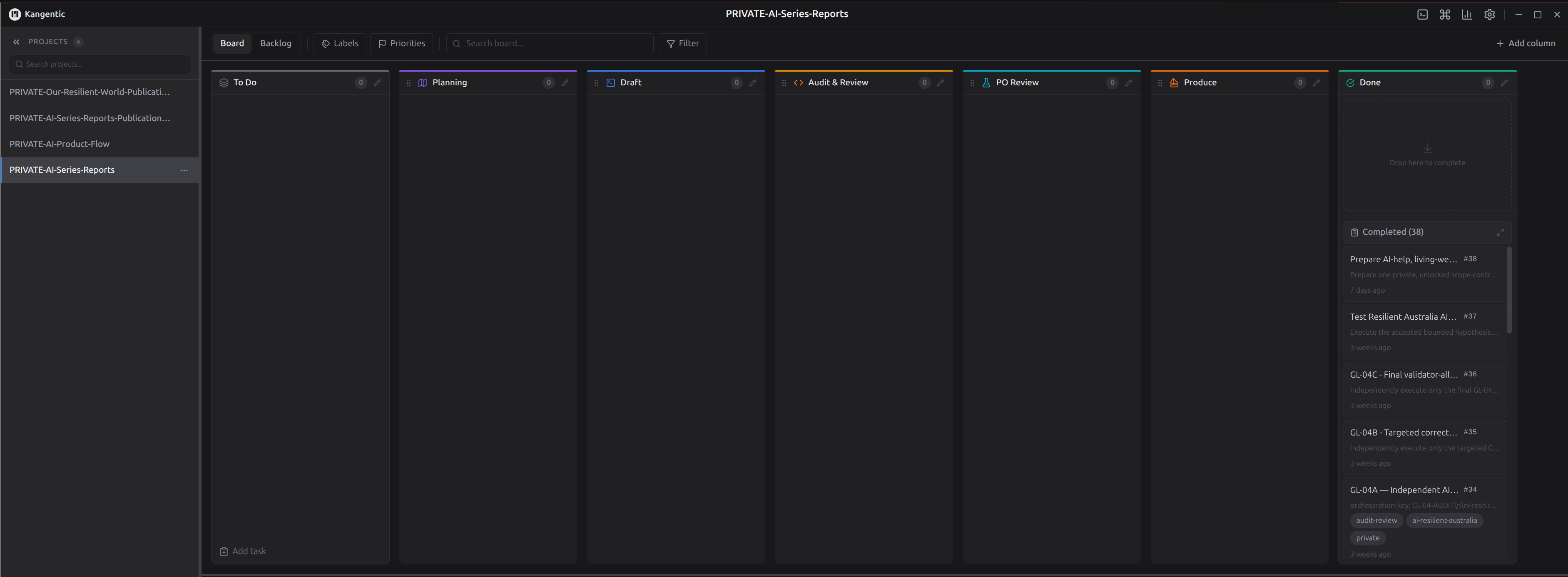
The Kangentic workflow — Codex (OpenAI) drafts and Claude checks Codex.
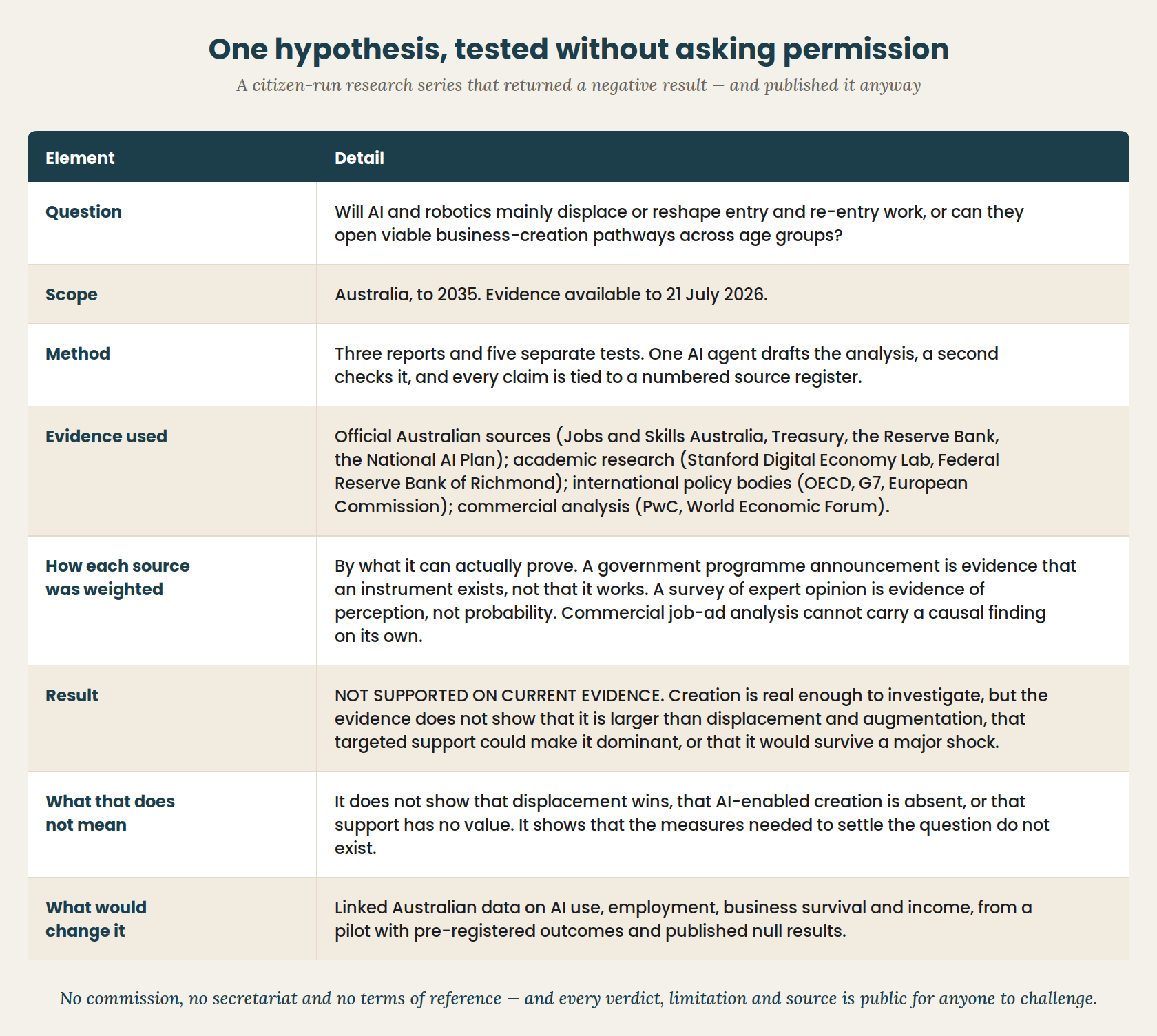
No commission, no secretariat and no terms of reference — and every verdict, limitation and source is public for anyone to challenge. Treat this as a demo of what can be done.
The answer came back negative. On the evidence available to 21 July 2026 the hopeful proposition is not supported. Business creation is real enough to investigate, but nobody can currently show that it is larger than displacement and augmentation, that targeted support would make it dominant, or that it would survive a major shock — largely because Australia does not collect the linked data on AI use, employment, business survival and income that would settle the question either way.
I want to be clear about why I am putting a negative result into an article arguing for optimism. A royal commission that spent two years and reported "we cannot yet answer this, and here is exactly what is missing" would be treated as a failure, which is precisely why commissions so rarely say it. In research that answer is the most useful thing you can produce, because it tells you what to measure next instead of what to announce next. The whole series is published with its verdicts, its confidence levels, its limitations and its sources, and with forms for anyone to submit a correction or new evidence that would change the result.
One person did that, with AI assistance, over a few weeks. The process is now automated and a new hypothesis (see AI Policy for more examples) can be tested and reviewed in a matter of hours. If a few thousand people do the same thing, publish their methods, label their evidence honestly and argue about the results in the open, then we have something no royal commission can produce: an evidence base that nobody owns, that anyone can audit, and that does not stop when the reporting date passes.
What people need in order to take part
Three things, and none of them is a degree in computer science.
The first is compute. Access to capable AI is now the difference between having an opinion about something and being able to test it. It should be treated the way we treat access to a public library, not as a consumer product that people are left to buy for themselves.
The second is AI literacy, and this should not mean teaching everyone to become a programmer. It should mean helping people understand what AI is good at, where it is unreliable, how to check its work, how to protect private information, and how to use it to extend rather than replace their own judgement. That belongs in lifelong learning, through schools, libraries, TAFEs, community organisations, workplaces and local government — not only through universities and large companies in capital cities. I will be writing more about this and demonstrating how AI can be used by anyone to do and share research in the role of a citizen scientist.
The third is time. A four day week has already been suggested as one way to reduce the potential loss of jobs caused by AI, but the more interesting benefit is that it gives people time to think — time to think about the world, about what is important to them, and about how they might be actively involved in shaping their own futures. Participation is not free, and we should stop pretending that it is.
Regional Australia should be first in line rather than an afterthought. Regional communities live with bushfire, flood, water, health, aged care, transport, agriculture, energy and small-business viability arriving as one connected problem. They are not managed that way. Councils, state agencies and federal programmes each hold one piece, on separate budgets, separate timetables and separate plans, and nobody is responsible for the interactions between them. That is precisely the gap that open models and citizen-run analysis could fill, because the people living with the connections are the ones best placed to describe them.
What is actually left for government
Less than the current debate assumes, and government is not doing that part well either.
Regulation and safeguards are genuinely necessary, and real harms need policing. Australia also needs enough sovereign capability to understand the systems it depends on, to protect sensitive information and to run critical services — informed interdependence rather than technological isolation, and a conscious choice rather than the accidental result of never building any capability of our own.
Data centres are the immediate test of whether any of this is understood. Data centres place real demands on land, electricity, water, construction capacity and network connections. Meeting the planning requirements is the floor, not the standard, and at present no approval process in this country asks the question that matters:
How will this infrastructure make the host community more resilient?
The expected costs, benefits and trade-offs should be modelled openly before approval and measured afterwards, and where the benefit cannot be shown it should not be assumed. On current arrangements it is assumed almost every time.
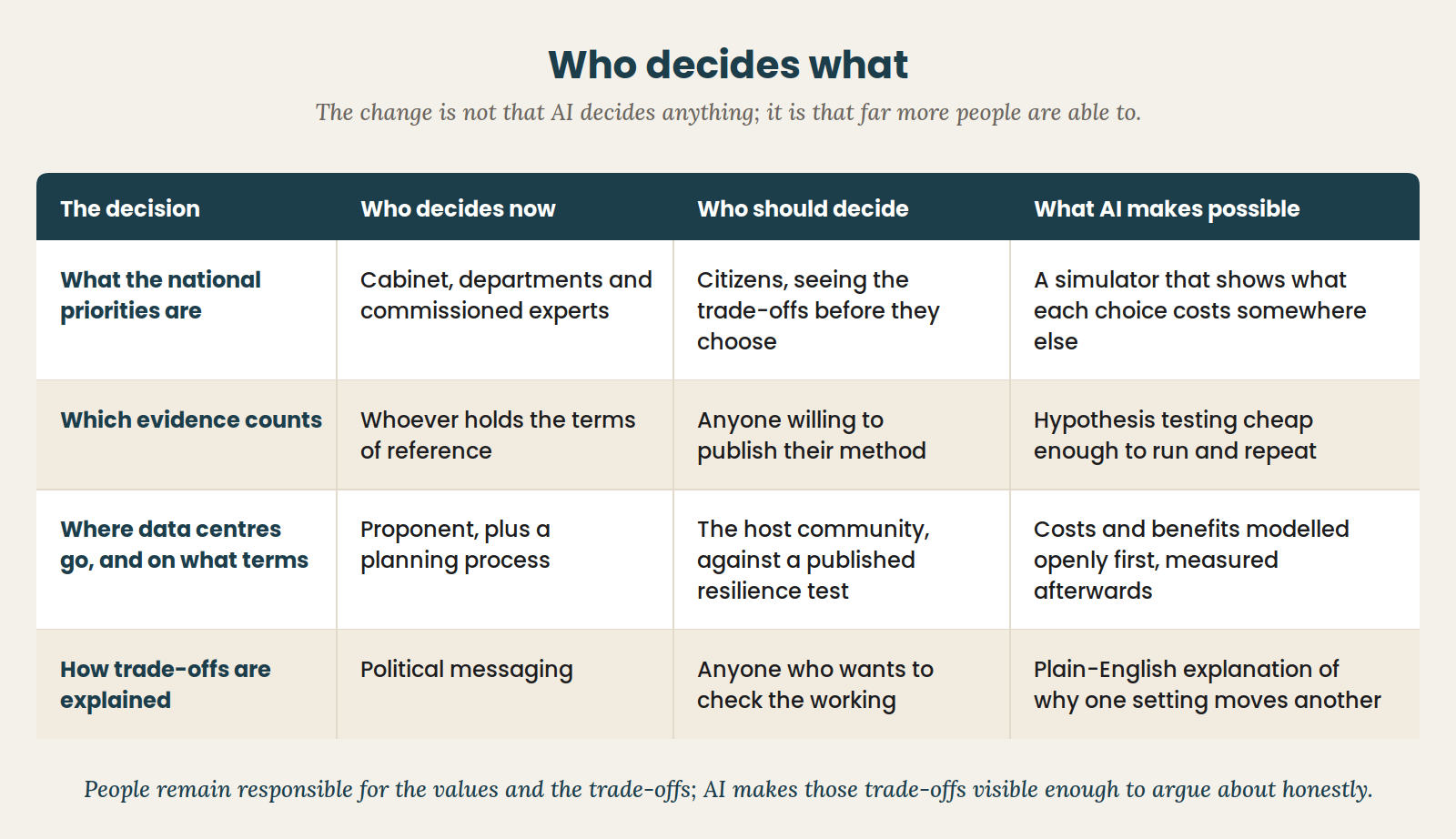
People remain responsible for the values and the trade-offs; AI makes those trade-offs visible enough to argue about honestly.
The choice
So Australians have a choice. We can treat AI mainly as a technology that needs to be controlled, which is the safe and familiar path and which ends in business as usual. Or we can treat AI as a capability to be used deliberately to build a more resilient country — building the evidence ourselves, modelling the trade-offs openly, and telling governments what our priorities are instead of waiting to be consulted about theirs.
To do this we must break our dependency on government to decide for us.
The question is not whether AI will change Australia. It will.
The question is whether we use that change mainly to protect existing systems, or to build something better.
Drafted by me, revised with AI.