

In my previous article, AI for a Resilient Australia: Who Sets the Priorities?, I suggested that the AI inquiries now under way may not ask the most important question: could AI help us move away from business-as-usual politics towards a different kind of politics, in which communities examine trade-offs and help set their own priorities?
Kate Chaney, the independent federal MP for Curtin, has published an AI Discussion Paper: Shaping the future of AI for Australia and invited feedback and ideas from everyone. I used my AI research workflow to prepare a detailed response: From Guardrails to National Resilience — Feedback on Shaping the Future of AI for Australia.
That paper was produced from my research and thinking, with OpenAI's Codex preparing the draft and Claude reviewing it. It argues that one practical demonstration could begin in Curtin:
Start with one issue nominated and framed by Curtin residents, not by an AI company, government department or parliamentary office. It could be a local resilience question involving housing, energy, care, transport, small business or the costs and benefits of digital infrastructure.
One of the best ways to understand what AI might make possible is to conduct real, small-scale experiments. This article outlines how an electorate such as Curtin could do that, building on tools and workflows I have prototyped.
What effective community consultation involves
I use consultation broadly: a structured process that enables people affected by a public question to understand it, contribute their knowledge and views, and influence the decision. A survey can be part of that process, but collecting opinions is not the same as giving people time, evidence and an opportunity to consider alternatives and trade-offs.
The OECD has done significant research into citizen participation, saying it ‘…should begin with a genuine problem the public can help solve. The expected influence of participants, who needs to be involved, and how the decision-maker will use and respond to their input should be clear from the start.’ AI Discussion Paper; OECD citizen-participation guidelines
My approach starts from the proposition that representative democracy and our BAU politics are not fit for purpose. Politics is a competition, and parties win not by seeking cooperation but by promoting division. The result is that we, the people are asked to vote once every three or four years and put up with the spectacle to the next electoral cycle.
Indeed it has been said that democracy is the worst form of Government except for all those other forms that have been tried from time to time.…’ Winston Churchill 2016
I think with the assistance of AI, it is time we start developing a better form of democracy and move from representative democracy towards participatory democracy.
A draft workflow for consultation assisted by AI
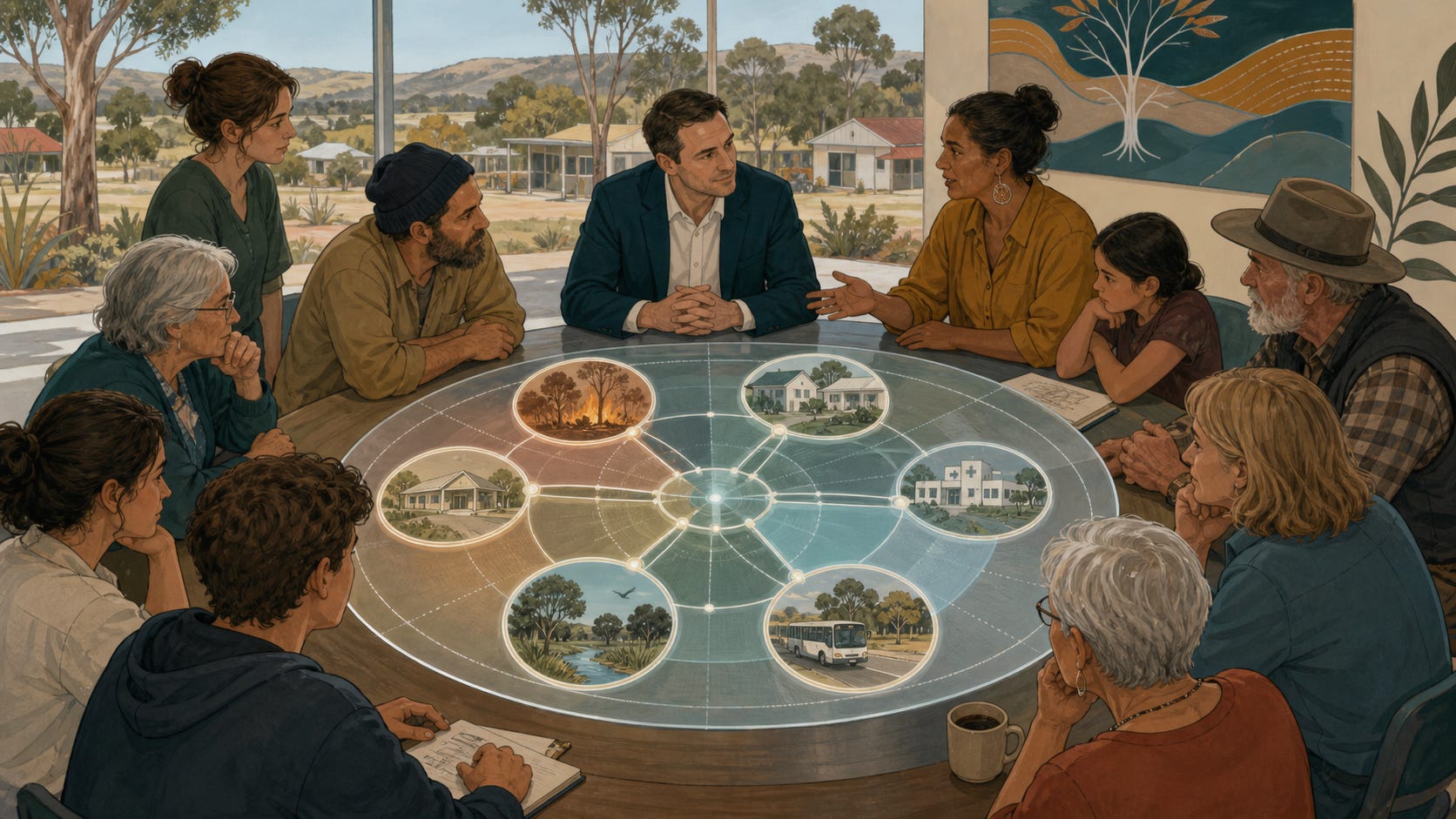
Ms Chaney has already used a community survey to understand her electorate's concerns about AI. If the survey captures a broad range of issues, AI tools could help organise those responses into a transparent model that lets people explore the relationships and trade-offs before providing further feedback.
To show how the idea might work, I built a demonstration for the Bega Valley, where I live.
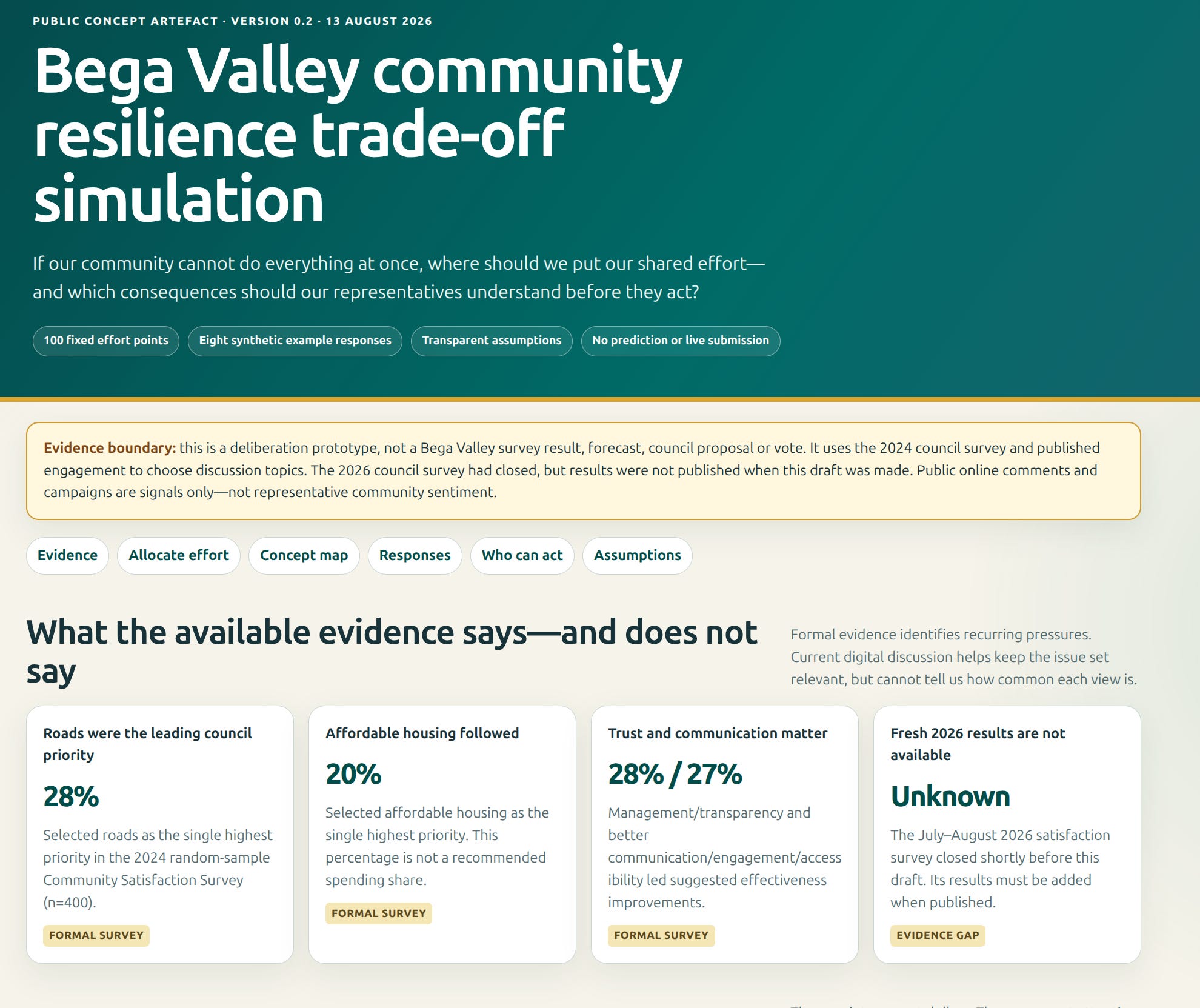
Try the Bega Valley Community Resilience Simulation. It is a demonstration: nothing is saved and no personal information is collected.
Participants distribute 100 points among possible priorities. The constraint forces a choice: giving more weight to one issue leaves less for another.
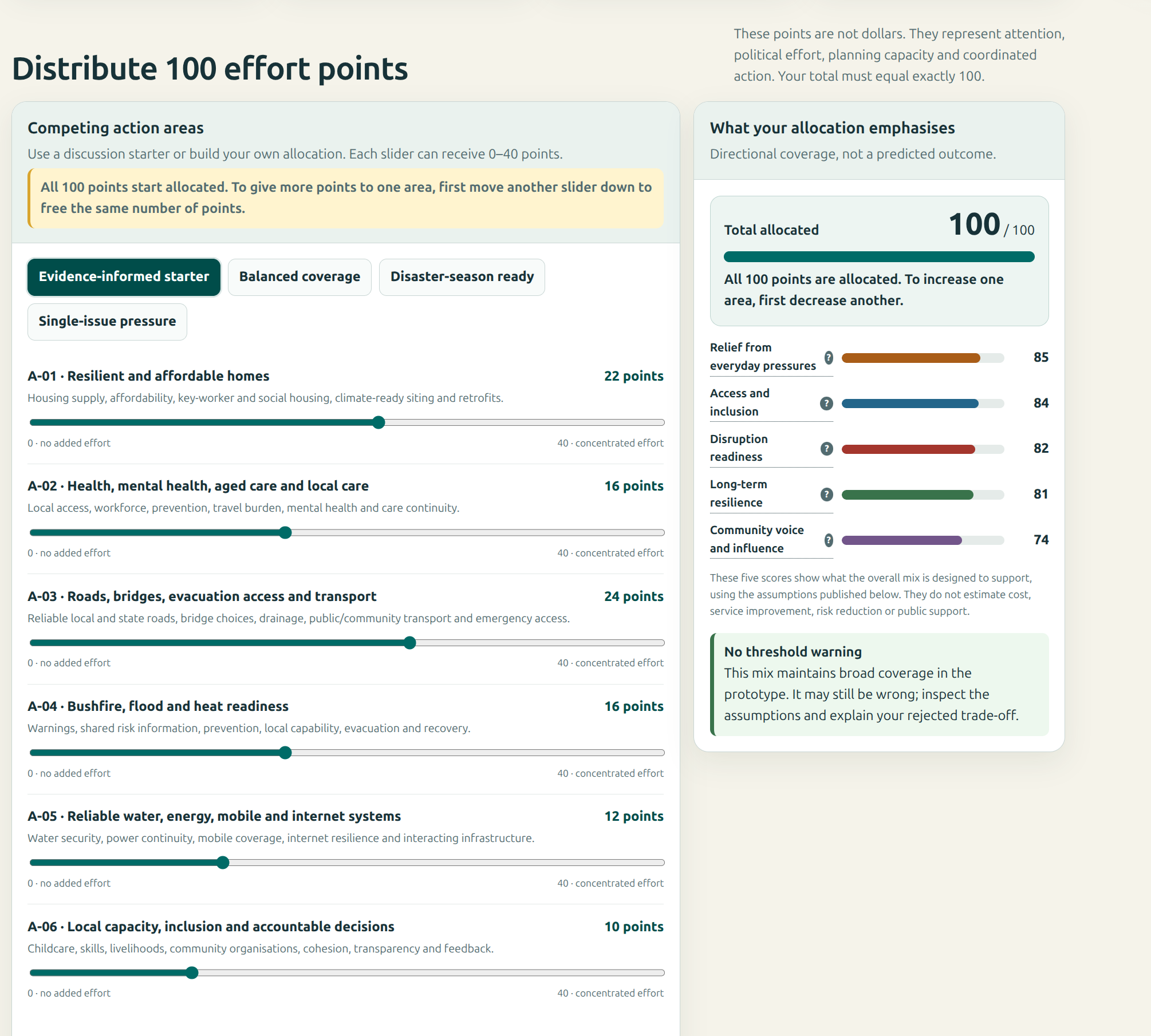
My highest priority is preparation for the next severe bushfire season. That judgement is shaped by my experience of fires in the Bega Valley in 2018 and during the 2019–20 Black Summer fires.
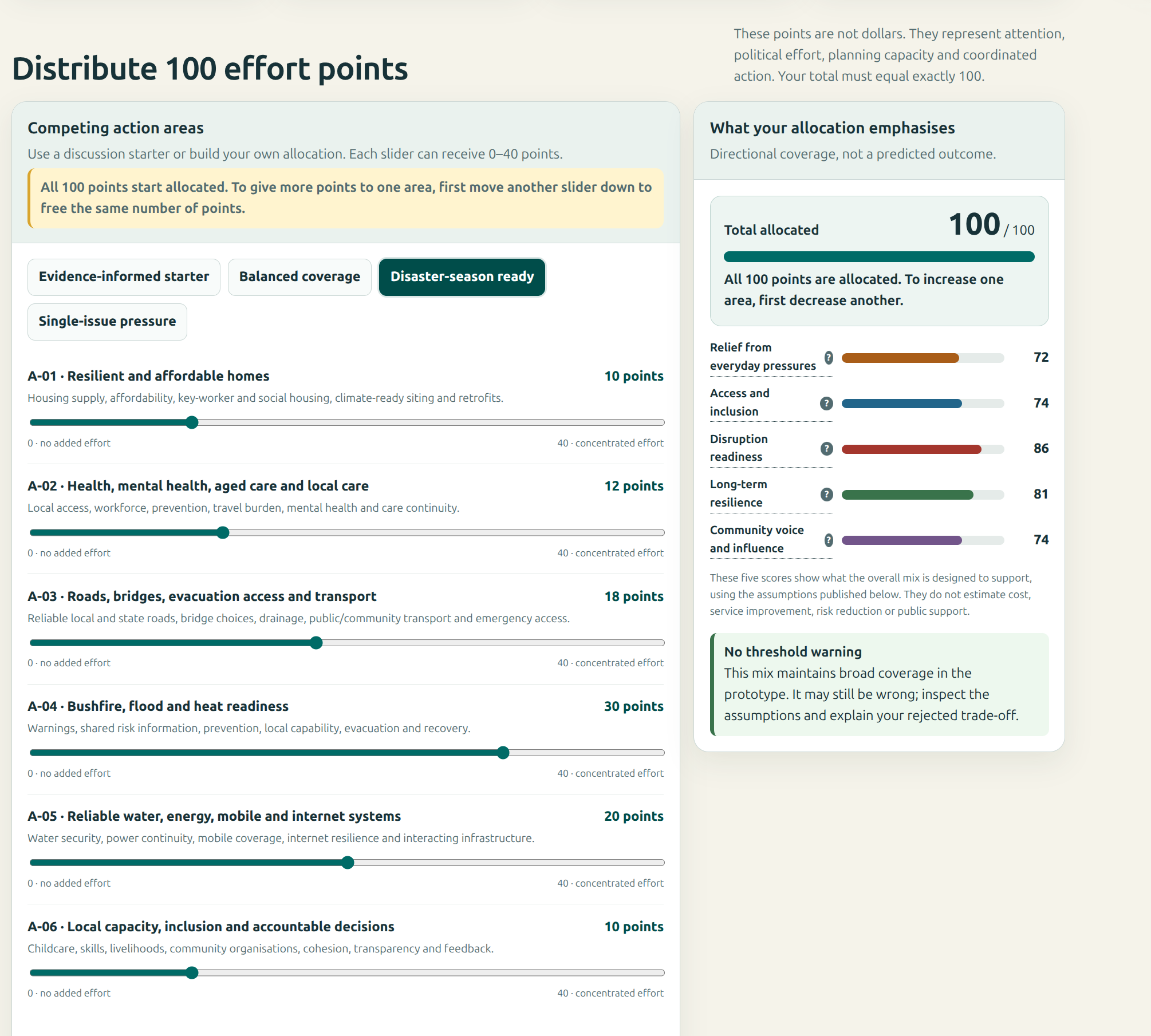
The model also shows how issues that initially appear separate can overlap.
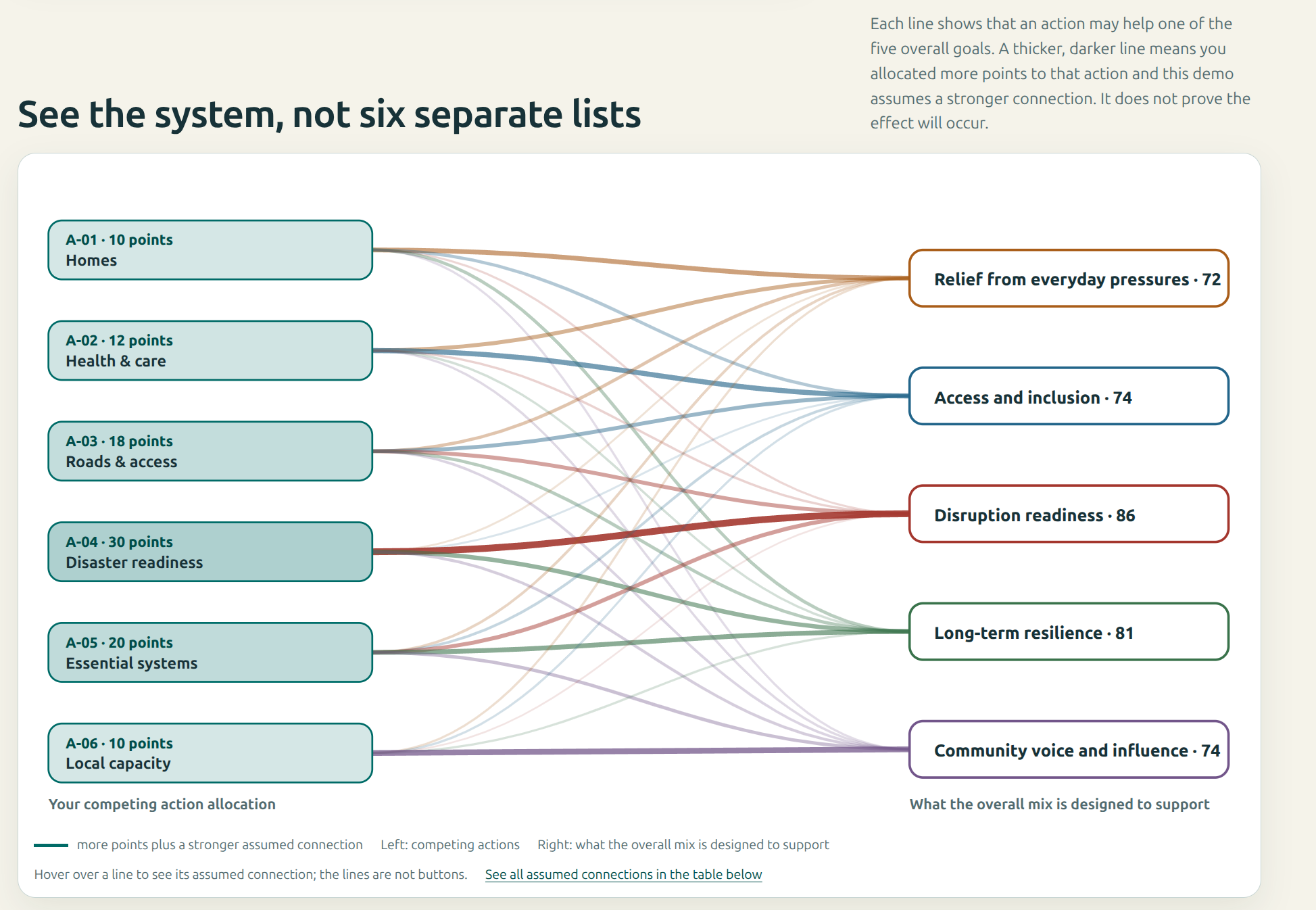
From priorities to testable options
The same method can be adapted to a specific issue. I created a Demo Bushfire Readiness Simulator to explore actions that might reduce risk before summer 2026–27.
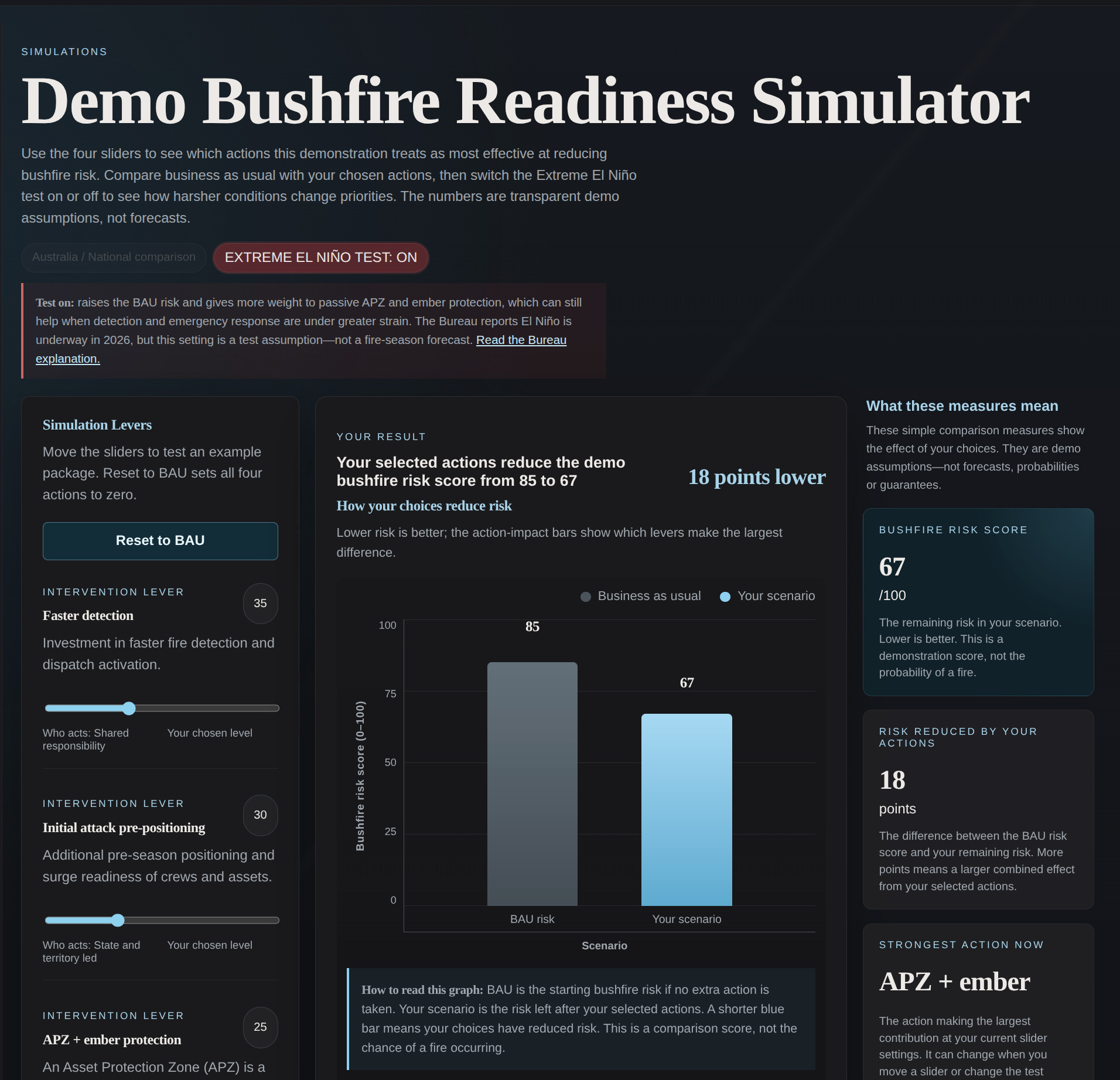
I developed it in the context of the strong El Niño under way in August 2026. For my own situation, the model suggested that reducing hazards around my home was the most useful action I could take quickly. That is a result from my simulation using its declared assumptions. It is not general bushfire advice, a forecast, or evidence that the same intervention will be best for every household or community.
The research behind this demonstration was prepared using OpenAI's Codex and then reviewed with Claude. The sources and assumptions are exposed so that other people can question them.
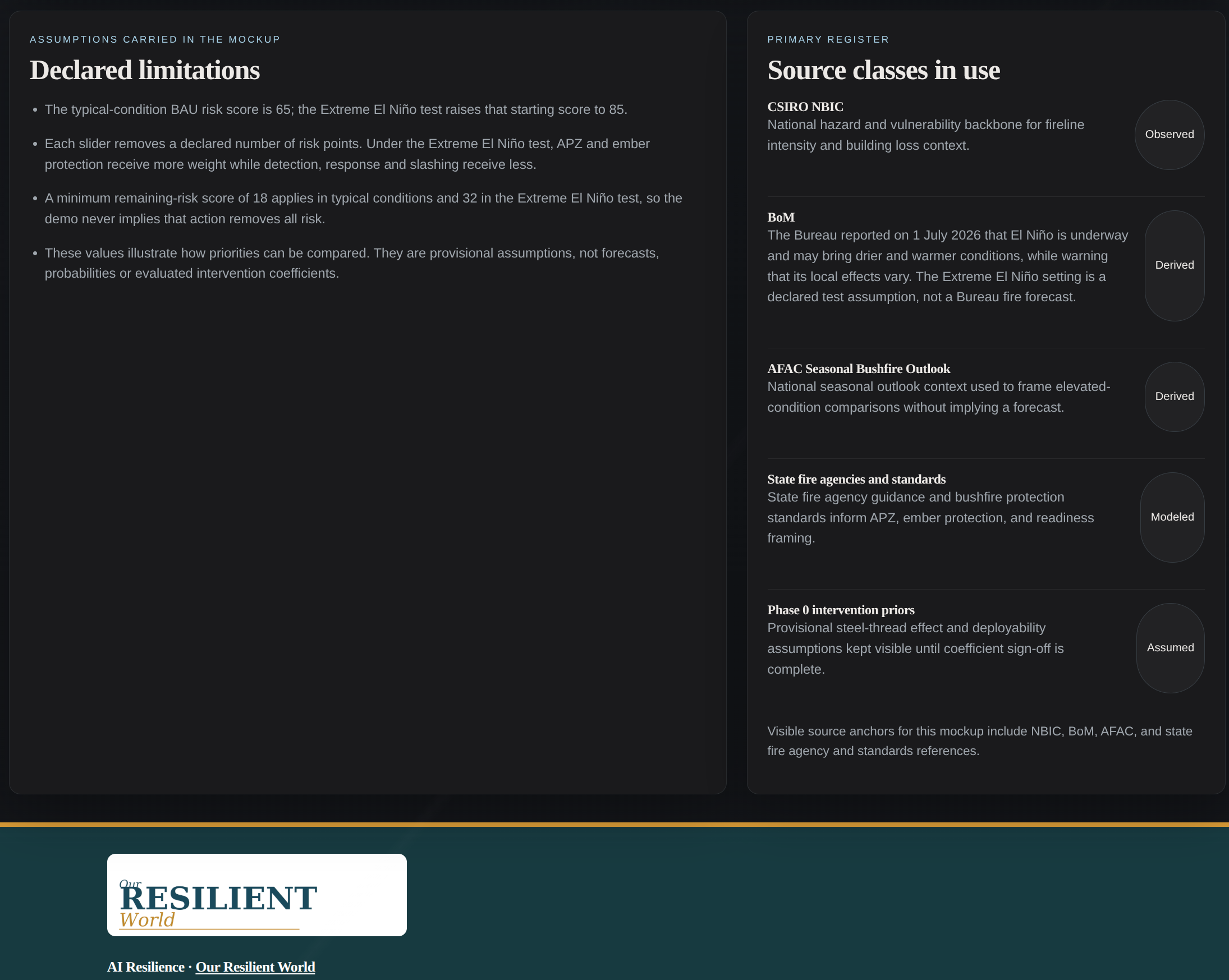
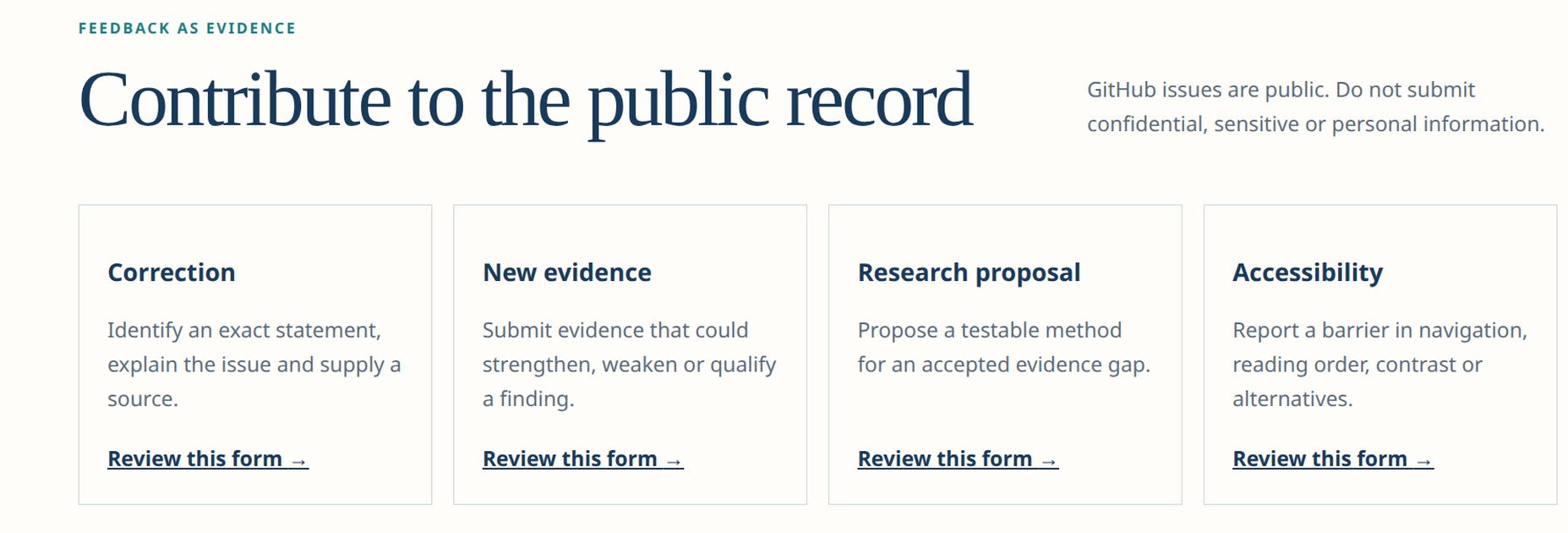
Using a second AI model is a minimum check in my personal workflow. It is not enough but it does demonstrate what is possible. The AI policy research, policy papers and simulations are set up so that anyone can suggest a correction or provide new evidence.
Using established simulations to test our assumptions
I use the phrase citizen scientist when thinking about how people could find ways to cooperate together using these types of simulation tools. If people are to become more actively involved in setting priorities, they must be willing to adjust their opinions when better evidence or modelling challenges their assumptions. The most important test for anyone is not if your opinion is based on data, but are you prepared to change your opinions when you are exposed to new information. How easy is it to fail that test.
For example, I expected that rapidly reducing coal use would produce a much larger fall in projected global temperature by 2100. When I tested that idea in the EN-ROADS climate simulator, the result was less dramatic than I expected because changing one part of a connected energy system can affect other fuels and behaviours.
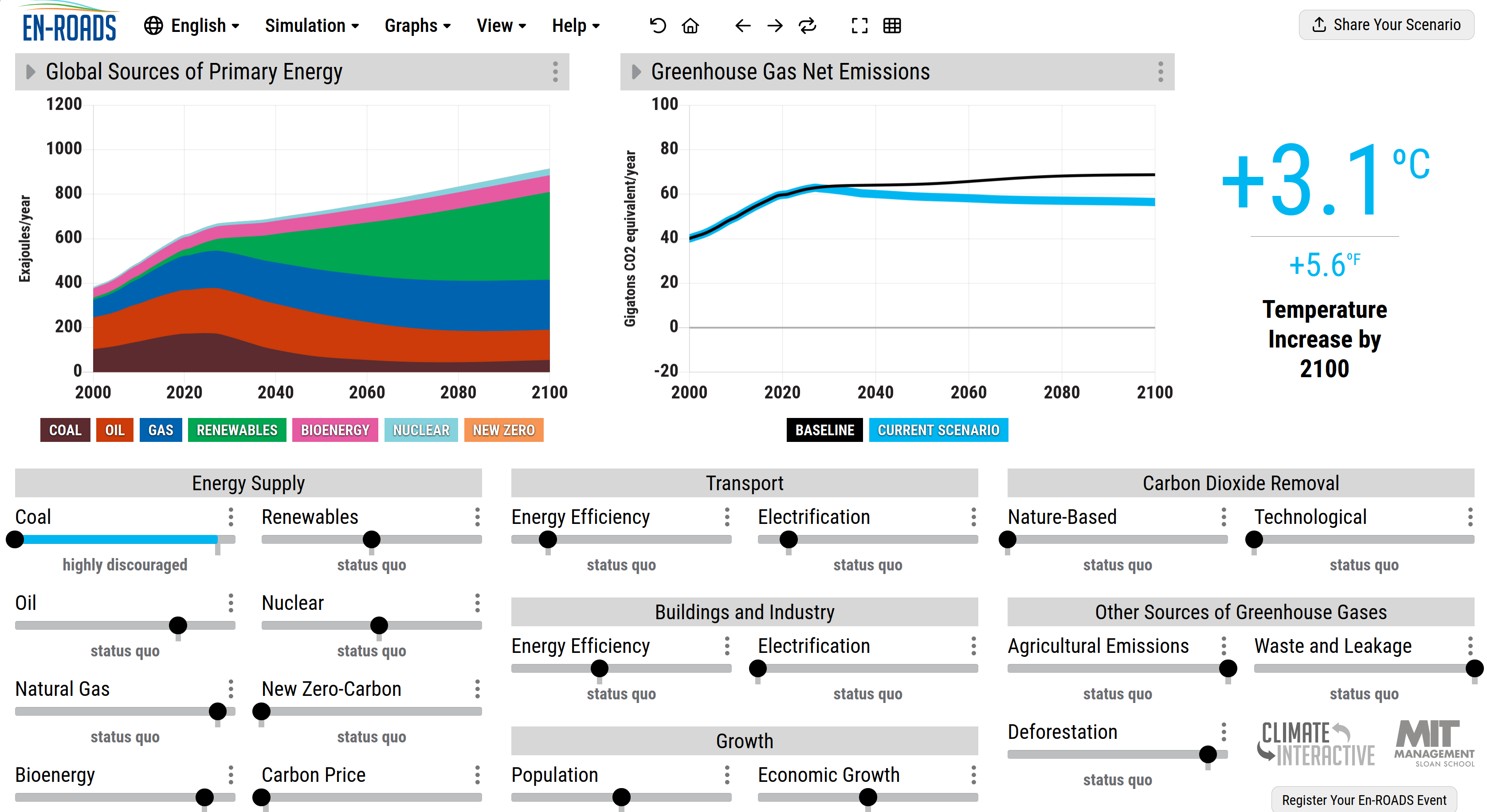
I have used EN-ROADS for more than five years, completed its online training, and reviewed the EN-ROADS Technical Reference.
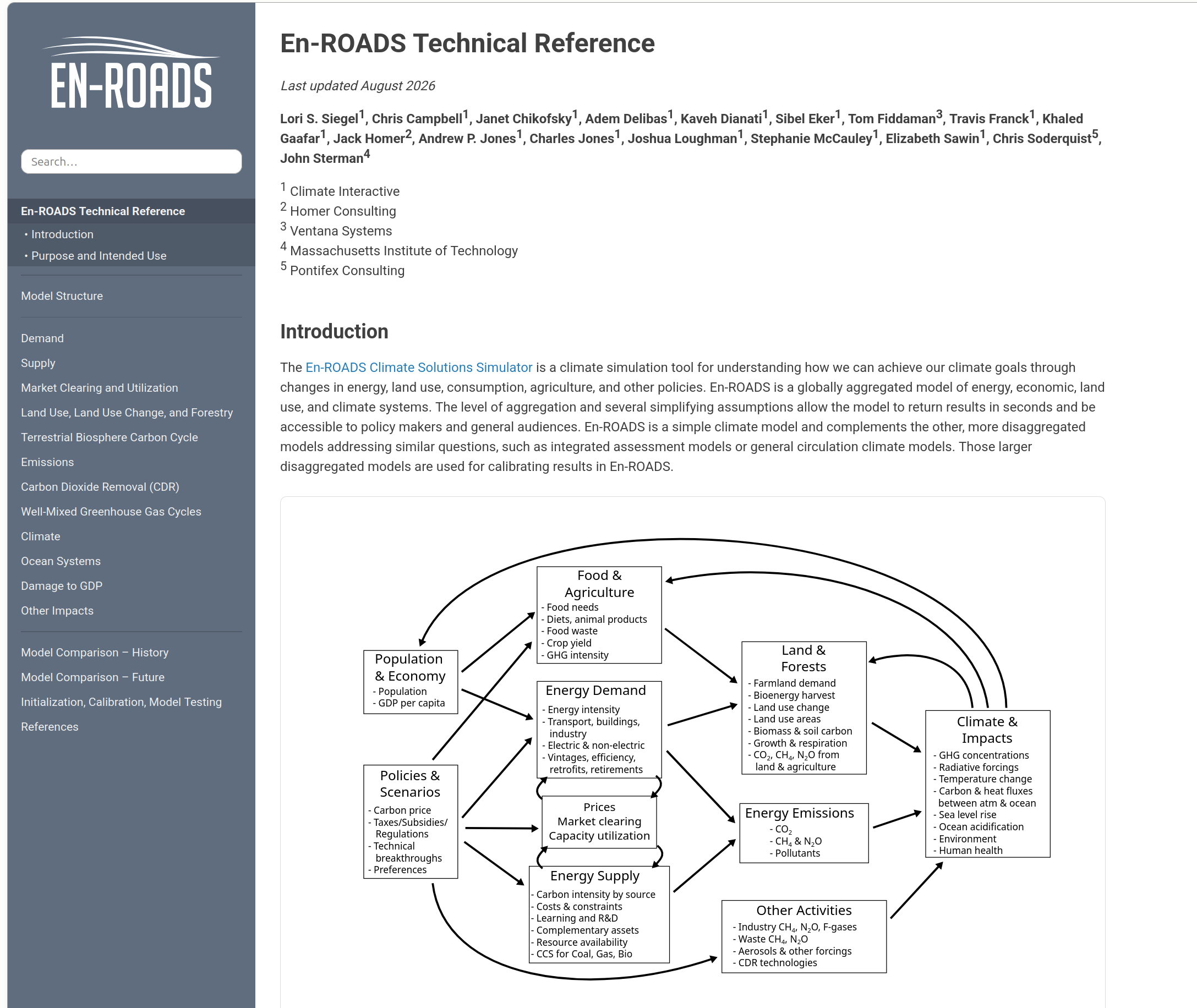
I also asked Claude and ChatGPT to assess the documentation. The prompts were identical, with the addition of a request for ChatGPT to provide its results in a table format. The results are summarized below:
Fundamental relationship between greenhouse-gas emissions, concentrations and global warming — Very high: Core physical relationships are well established.
Broad behaviour of the global energy–climate system — High: Useful for learning how major parts of the system interact.
Relative leverage of broad intervention packages — High: One of the model's strongest educational uses.
Approximate global effect of a policy package — Medium–high: Results depend on socioeconomic, technology and implementation assumptions.
Exact temperature from a slider combination — Medium: A scenario result, not a prediction.
Economic damages — Low–medium: Estimates and modelling choices vary substantially.
Outcomes for an individual country or community — Low: EN-ROADS is essentially a global model and is not designed for local forecasts.
What governments and communities will actually do — Inappropriate use: The model explores “if this, then approximately that”; it does not predict human choices.
EN-ROADS is a sophisticated product that has been developed over many years but it is not a predictive model. What is does do though is provide a way for anyone who can wear the lens of ‘citizen scientist’ to examine the trade-offs and start to understand which choices have the biggest impact.
What a real electorate demonstration would require
The examples in this article are proofs of concept. They do not establish that participants are representative, that the results are accurate enough for a public decision, or that an MP will receive or act on them.
The aim is not to manufacture consensus. It is to help people understand the trade-offs between problems/opportunities. It is to provide our MPs with the opportunity to have a discussion around these trade-offs with their voters. It is to help people participate in government.
Conclusion
AI-assisted research and simulation create capabilities that were previously available mainly to governments, universities and well-funded organisations. They could now help ordinary people examine difficult choices—but only if the tools are transparent and allow anyone to challenge the assumptions and data and modelling aspects of the simulation.
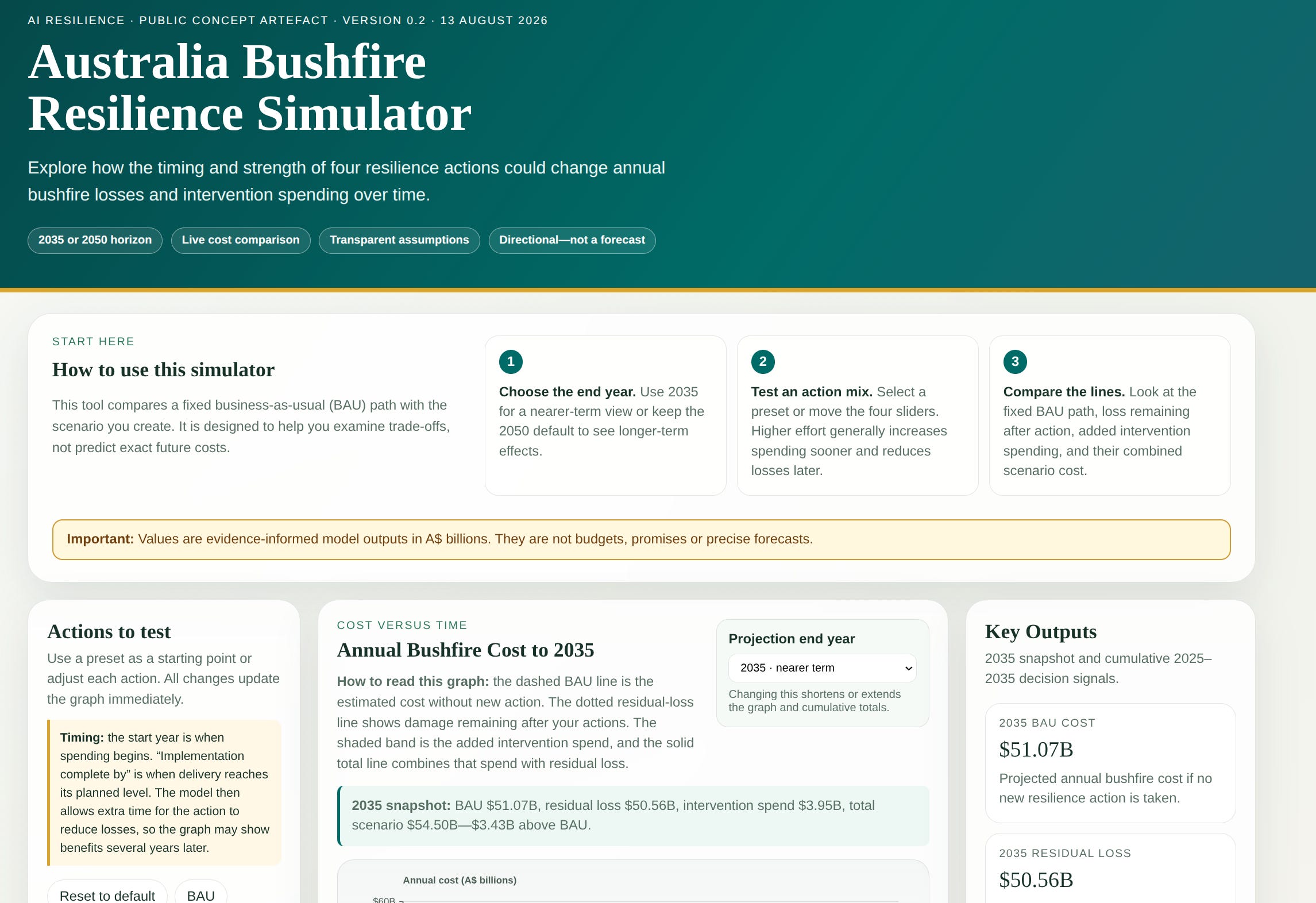
I am continuing to test the approach. Another example is the Australian Bushfire Resilience Simulator.
The longer-term goal is to help people do more than vote once every three years and hope that the government they elect can move beyond business as usual. It is to create practical opportunities for citizens to work together, test hypotheses and change their views when the evidence warrants it.
I know that my own hypotheses and assumptions are often wrong. That is why I use AI models to challenge them and why I want the sources, assumptions and corrections to remain visible. The scientific habit that matters most is not simply relying on data. It is being willing to change our minds when the evidence shows that our original view was wrong.
If you have a testable hypothesis, add a comment. I will run suitable ideas through my AI Kangentic workflow and publish the result for others to question.